In today’s digital world, almost every service requires an online account. From government portals to banking apps and educational platforms, users are constantly asked to remember usernames and passwords. But is this approach still practical when the number of services keeps increasing every day?
This is where modern identity systems come into play. A centralized login approach such as SSOID simplifies access by allowing users to sign in once and use multiple services without repeated authentication. It represents a shift from fragmented digital identities toward a more unified and efficient system.
But does this mean traditional login systems are no longer useful? Or do they still have advantages in certain situations? To understand which approach is better, we need to compare both systems in detail, focusing on security, usability, and real-world performance.
Understanding Traditional Login Systems
Traditional login systems are the most widely used authentication method across the internet. In this model, each website or application requires a separate account. Users create individual credentials—usually a username and password—for every platform they use.
While this method is straightforward, it comes with several challenges. As the number of accounts increases, users often struggle to remember passwords. This leads to repeated password resets, weak password usage, and sometimes even reuse of the same credentials across multiple platforms.
Another issue is inconsistency. Each system may have different security requirements, login interfaces, and verification methods. This lack of standardization can make the overall experience frustrating, especially for users who interact with multiple services daily.
Despite these limitations, traditional login systems are still widely used because they are simple to implement and give individual platforms full control over user authentication.
The Rise of Unified Login Systems
To solve the complexity of managing multiple accounts, centralized authentication systems were introduced. Instead of creating separate logins for every service, users authenticate once and gain access to multiple connected platforms.
This approach reduces friction and improves user experience. It also allows better coordination between services, especially in large ecosystems like government portals or enterprise networks.
A system like SSOID plays an important role in this transformation by acting as a single gateway for multiple digital services. Once a user is verified, they do not need to repeatedly enter credentials for every new service they access.
This concept is particularly useful in environments where users interact with several departments or applications within a single ecosystem.
User Experience: Convenience vs Repetition
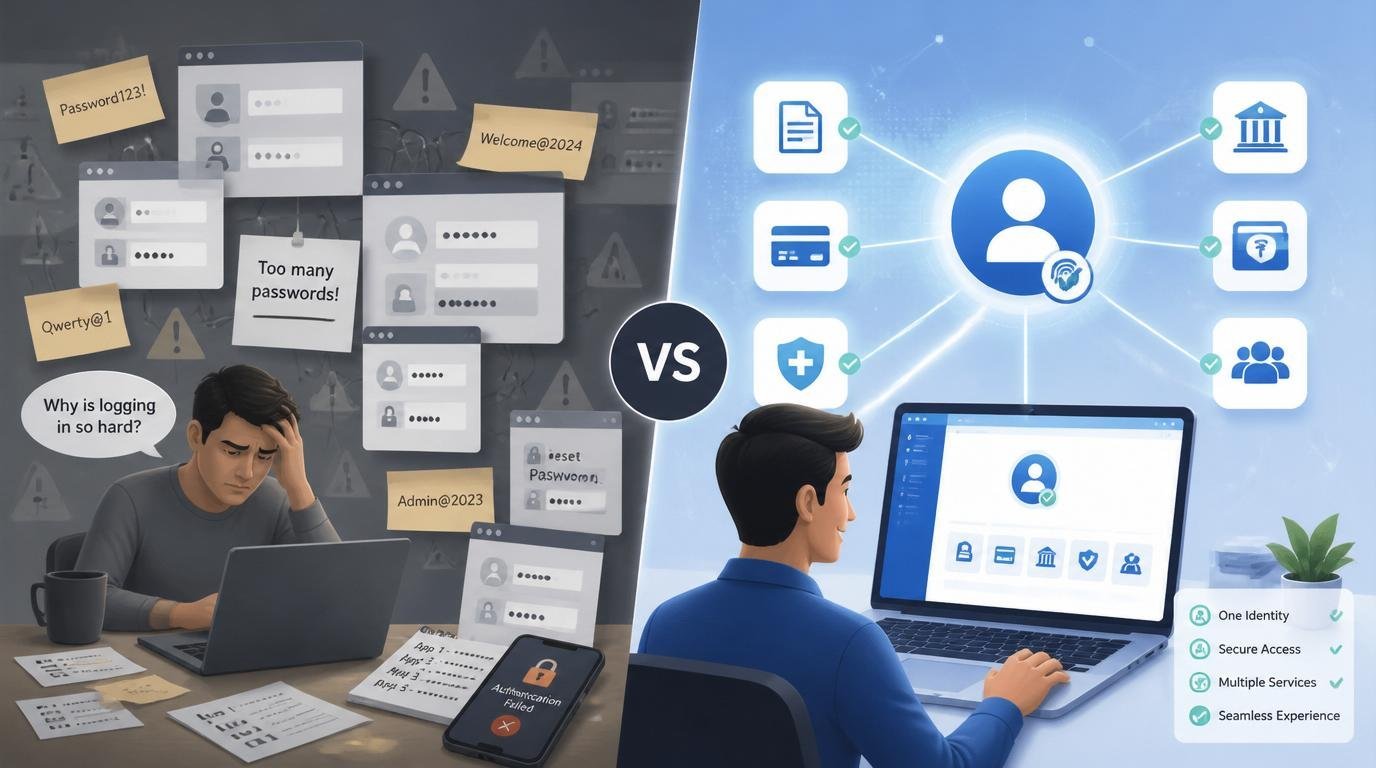
One of the biggest differences between the two systems lies in user experience. Traditional login systems require users to remember multiple passwords, which often leads to confusion and frustration. Have you ever struggled to recall which password belongs to which account?
On the other hand, centralized login systems significantly reduce this burden. With a single authentication point, users can access everything without repeatedly signing in. This makes the entire process smoother and more efficient.
In the middle of this comparison, SSOID highlights how unified access can simplify complex digital interactions. Instead of juggling multiple credentials, users rely on one verified identity to move across services seamlessly.
However, convenience also comes with responsibility. If a centralized account is compromised, the impact can be broader compared to a single traditional account. This trade-off is an important factor to consider.
Security Comparison: Multiple Layers vs Centralized Protection
Security is one of the most debated aspects when comparing both systems. Traditional login models distribute risk across multiple accounts. If one account is compromised, others remain unaffected. This isolation can be seen as an advantage in certain cases.
However, users often weaken security by using similar passwords across different platforms. This creates vulnerabilities that attackers can exploit across multiple accounts.
Centralized systems, in contrast, rely on stronger authentication mechanisms such as encryption, session tokens, and multi-step verification. While this improves overall protection, it also creates a single point of failure if credentials are not properly secured.
Balancing convenience and security becomes crucial in modern digital environments, especially when sensitive data is involved.
Efficiency and Performance Differences
Traditional systems often require repeated authentication requests for every service. This not only slows down user access but also increases server load due to constant login checks.
Centralized systems reduce this overhead by creating a single authenticated session. Once verified, users can move between services without restarting the login process. This improves performance and reduces unnecessary system strain.
From an administrative perspective, centralized identity management also simplifies monitoring and user management. It becomes easier to track activity, manage permissions, and ensure consistent security policies across services.
At this stage, SSOID demonstrates how unified authentication can streamline both user interaction and backend operations, making systems more efficient overall.
Accessibility and Integration
Another important factor is accessibility. Traditional login systems often create barriers for users who are not tech-savvy. Managing multiple accounts can become overwhelming, especially for people who are not familiar with digital platforms.
Centralized login systems solve this issue by reducing complexity. Users only need to remember one set of credentials, making digital services more inclusive and easier to use.
Integration is also a major advantage. Instead of building separate authentication systems for each service, organizations can connect everything under a unified framework. This reduces development effort and improves consistency across platforms.
Risks and Limitations of Both Systems
No system is perfect, and both approaches have limitations. Traditional systems suffer from password overload, weak security practices, and inconsistent user experience. However, they offer independence between services, which can be beneficial in certain scenarios.
Centralized systems, while more convenient, introduce dependency on a single authentication point. If that system experiences downtime or security issues, access to multiple services can be affected at once.
This trade-off between independence and convenience is at the core of the debate between the two models.
Which System Is Better?
Choosing between traditional login systems and centralized authentication depends on the context. For small platforms or independent services, traditional systems may still be sufficient. They are simple, flexible, and easy to manage.
However, for large ecosystems where users interact with multiple services regularly, centralized systems offer a much better experience. They reduce complexity, improve efficiency, and enhance usability.
The growing demand for seamless digital access shows a clear shift toward unified identity systems. As technology evolves, users increasingly prefer convenience without sacrificing security.
Conclusion
The debate between traditional and centralized login systems is not about eliminating one in favor of the other. Instead, it is about understanding where each system fits best.
Traditional systems continue to serve as a reliable foundation for standalone platforms, while centralized systems represent the future of integrated digital experiences.
By simplifying access and improving efficiency, modern identity solutions are reshaping how users interact with online services. In this evolving landscape, SSOID reflects a broader movement toward smarter, more connected, and user-friendly authentication systems.
As digital ecosystems continue to expand, the demand for seamless, secure, and unified access will only grow stronger, making centralized login models an increasingly important part of everyday digital life.